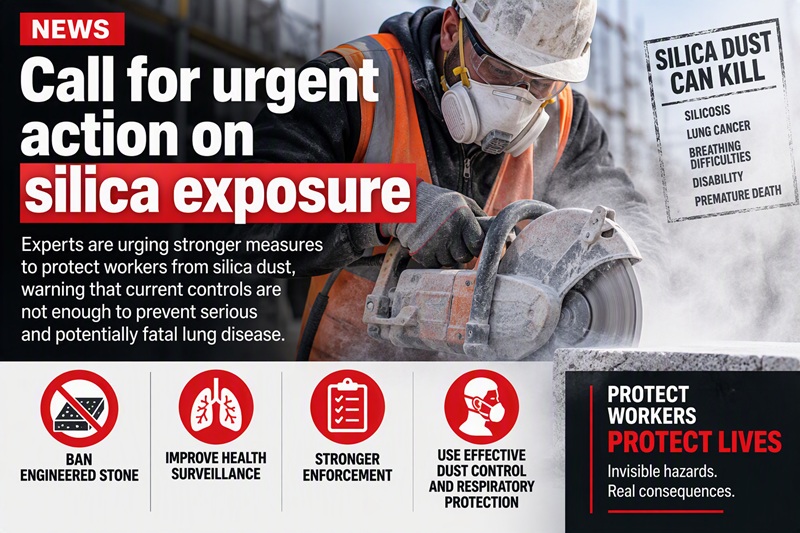
Safety experts and legal representatives are calling for stronger measures to protect workers from exposure to respirable crystalline silica (RCS), warning that current controls may not be enough to prevent life-changing and potentially fatal lung disease. [rcimag.co.uk], [cms.law]
At the recent Silicosis, Engineered Stone and the Fight for Safer Workplaces event held during TUC Congress, Thompsons Solicitors urged the UK Government to introduce a nationwide ban on engineered stone and strengthen protection for workers exposed to silica dust. The call follows enforcement activity by the Health and Safety Executive (HSE), which has uncovered serious failures in workplaces handling engineered stone. [rcimag.co.uk], [cms.law]
Silica dust is generated when materials such as engineered stone, concrete, brick and natural stone are cut, drilled or polished. When inhaled, the dust can penetrate deep into the lungs and cause silicosis, an irreversible disease that can lead to severe breathing difficulties, disability and premature death. Silica exposure is also linked to lung cancer and other respiratory illnesses. [cms.law], [hse.gov.uk]
The HSE recently launched dedicated guidance on engineered stone and began a programme of more than 1,000 inspections across Great Britain. Inspectors have already identified failings relating to water suppression, dust extraction, respiratory protective equipment and health surveillance. [rcimag.co.uk], [cms.law]
Among the proposals being advanced are:
✅ A UK-wide ban on engineered stone
✅ Improved screening and health surveillance for exposed workers
✅ Stronger reporting and enforcement requirements
✅ Greater awareness of silica risks across all industries
✅ Enhanced monitoring of occupational lung disease cases [rcimag.co.uk], [britsafe.org]
Key Safety Message
Invisible hazards can be just as deadly as visible ones. Employers must ensure suitable risk assessments, effective dust control measures, appropriate respiratory protection and regular health surveillance wherever silica dust is generated. Preventing exposure today can prevent irreversible disease tomorrow. [hse.gov.uk], [cms.law]
Source: Thompsons Solicitors, Health and Safety Executive (HSE), and British Safety Council. [rcimag.co.uk], [britsafe.org]